How To Easily Record a Symphony With Only Four Microphones

My friends at Roswell Pro Audio have been great to me in the last month.
They let me borrow a pair of their K47s as well as a couple Delphos condensers to try out.
And let me tell you, they did not disappoint.
I’ve been using them on voice-over, vocals and acoustic guitar recording in the home studio. Every time, they exceeded my expectations.
But that’s not all.
A few weeks ago I had the awesome opportunity to record a symphony for a documentary over at an old Wild West movie set where they used to make John Wayne Westerns.
It’s called Old Tucson Studios:

How to Record a Symphony With 4 – 6 Microphones
As an ensemble gets larger and more complex, sometimes you need to simplify your set up.
In our case, we used Roswell’s K47s as a stereo pair in addition to the two Delphos microphones flanking the sides. These outriggers served the purpose of widening up the sound as well as capturing a more direct sound from the strings.

Although major Hollywood symphony recordings rely on complex setups with section miking and such, most of the sound still comes from the main stereo pair and a pair of outriggers.
So when you’re working with a small budget, you simplify.
The ORTF Configuration by the Conductor
We used the ORTF stereo mic technique, as recommended by the experts I talked to. Special thanks to Haukur Pálmason for the assist and the consultations!
According to Wikipedia:
“The ORTF stereo microphone system, also known as Side-Other-Side, is a microphone technique used to record stereo sound.

It was devised around 1960 at the Office de Radiodiffusion Télévision Française (ORTF) at Radio France.
ORTF combines both the volume difference provided as sound arrives on- and off-axis at two cardioid microphones spread to a 110° angle, as well as the timing difference as sound arrives at the two microphones spaced 17 cm apart.
The microphones should be as similar as possible, preferably a frequency-matched pair of an identical type and model.
The result is a realistic stereo field that has reasonable compatibility with mono playback. Since the cardioid polar pattern rejects off-axis sound, less of the ambient room characteristics are picked up. This means that the mics can be placed farther away from the sound sources, resulting in a blend that may be more appealing. Further, the availability of purpose-built microphone mounts makes ORTF easy to achieve.
As with all microphone arrangements, the spacing and angle can be manually adjusted slightly by ear for the best sound, which may vary depending on room acoustics, source characteristics, and other factors. But this arrangement is defined as it is because it was the result of considerable research and experimentation, and its results are predictable and repeatable.”
A Spaced Pair Capturing the Sides
The Roswell K47s in ORTF captured the entire orchestra, while the spaced pair of Delphos mics widened the sides and captured the strings.
After some test recordings and finding the best placement for the mics we ended up with the configuration you can see in this image:
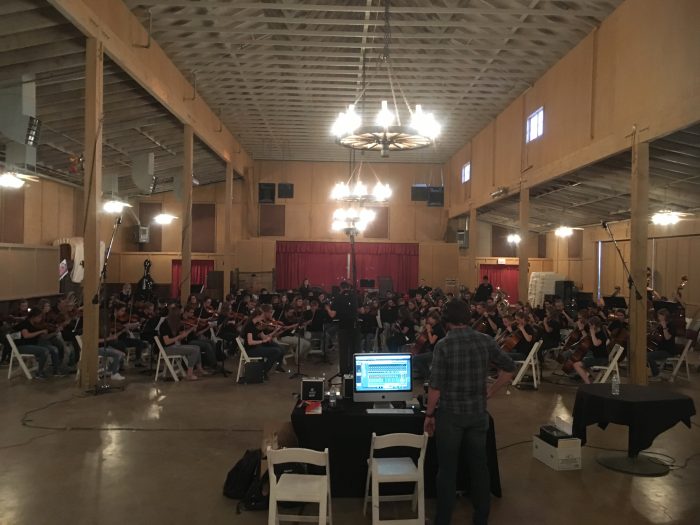
We also threw up an X/Y pair in the very back of the room to capture the ambiance, but it’s unclear whether we’ll use them or resort to digital reverb instead.
Grab the Opportunity When It Arrives
Although I didn’t have years of experience recording symphonies under my belt, I jumped at the opportunity and the challenge. I realized that this was just the same as any other recording session, only larger.
Ironically, the larger the recording session got, the simpler it became as well. Because of that, I needed microphones that could perform. The Roswell mics had exceeded my expectations in a home studio setting, and when I put them in front of a symphony, they excelled as well.
If you’d like to grab any one of their mics for your own studio, Matt over at Roswell is offering you an exclusive coupon code to get free shipping on your order.
Just use the code BB-FREESHIP when you check out and you’ll save on shipping and get an incredible addition to your mic locker.
Check out Roswell Pro Audio here.


Recording Tips



LEAVE A COMMENT